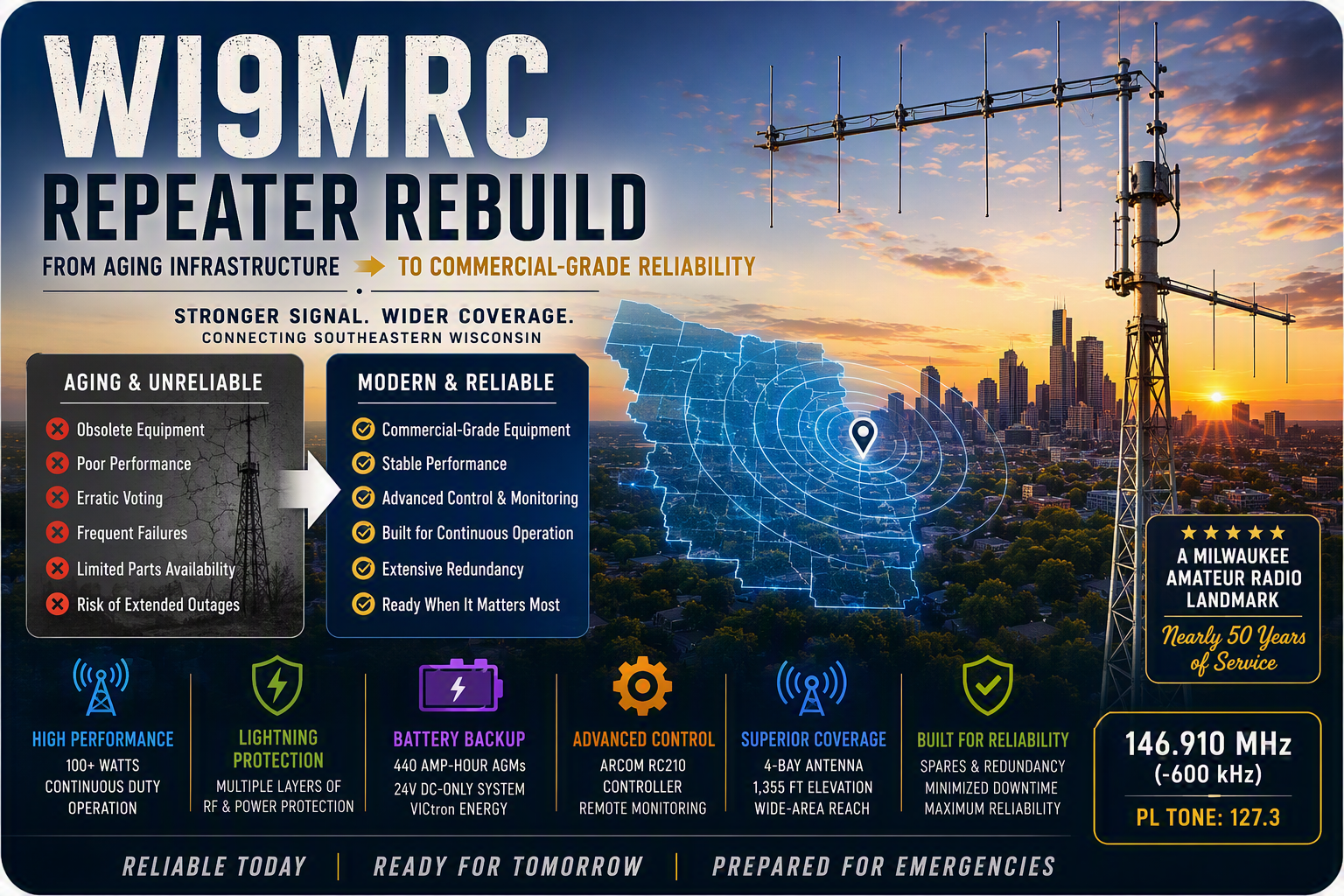
Rebuilding a Milwaukee Landmark: The WI9MRC Repeater Replacement Project
For nearly 50 years, the WI9MRC repeater has been a cornerstone of amateur radio communications throughout the Milwaukee area. It has supported daily communications, public service events, and emergency communications activities for generations of amateur radio operators. By late 2021, however, increasing reports of signal and audio problems began raising concerns about the long-term reliability of the system.
What began as a routine troubleshooting effort ultimately revealed a much larger problem: the repeater had reached the point where repairs alone could no longer ensure dependable operation. The Milwaukee Repeater Club made the decision to completely modernize the system and invest in infrastructure that would provide reliable service for decades to come.
Assessing the Existing System
In early October 2021, the Technical Committee received reports of audio and signal quality issues affecting the repeater. A comprehensive site visit was conducted on January 23 to investigate the problems and evaluate the overall condition of the equipment. Professional test equipment used during the assessment included an Aeroflex 2975 Service Monitor, Anritsu Site Master antenna analyzer, Telewave power meter, and Fluke 287 multimeter.
The findings were concerning. The repeater site consisted of aging equipment that had been assembled, modified, and expanded over many years. While the system had served the club well, much of the equipment was obsolete, difficult to repair, and no longer supported by manufacturers.
Original Equipment Configuration
- GE Master II Receiver Voter
- Kenwood TKR-740 Repeater
- Four Motorola CDM750 mobile radios serving as voter receivers
- DB Products UHF Receiver Multicoupler
- S-Com 7K Repeater Controller
- Celwave RF Isolator with dummy load
- IP Mobile Net 100-Watt Amplifier
- DuraComm DC Power Supply
- Aging deep-cycle backup battery
- Sinclair duplexer
- Abandoned TXRX duplexer mounted above the cabinet
- Multiple UHF bandpass cavities supporting remote receiver sites
The system had become a patchwork of aging technologies. In several cases, replacement parts were no longer available, and some critical components had been modified over the years in ways that complicated troubleshooting and repair.
Major Problems Identified
Receiver Voting System Failures
One of the most significant issues involved the GE Master II voter. The voter would frequently select the downtown receiver site even when stronger signals were available from other locations. Once it switched to the downtown receiver, the voter would often stop responding correctly and become locked on that site.
The problem occurred intermittently, making it difficult to predict or troubleshoot. Because the voter had reportedly been modified to function in its current configuration and had been out of production since the late 1980s, repair options were extremely limited.
Poor Receiver Sensitivity
Testing revealed that the primary receiver’s sensitivity had deteriorated significantly. The receiver opened at approximately 0.88 μV when it should have been closer to 0.22 μV or better. Reduced sensitivity directly impacts the repeater’s ability to hear weaker stations across the coverage area.
Unstable Audio Performance
Transmit audio deviation was found to be inconsistent. During testing with a continuous 5 kHz test tone, the deviation initially measured approximately 4.0 kHz, then climbed to 4.8 kHz, and finally dropped steadily. After one minute of transmission, deviation measured only 2.9 kHz.
This type of variation can produce inconsistent audio quality and affect overall intelligibility.
Severe Frequency Drift
Perhaps the most alarming discovery was transmitter frequency instability. During a one-minute test, the transmitter frequency drift observed was far beyond acceptable limits for reliable repeater operation.
Even though the supply voltage remained stable at 13.1 volts throughout testing, the repeater’s frequency shifted significantly during transmission. This pointed toward a likely failure within the Kenwood repeater’s internal oscillator or power conversion circuitry.
Failing Amplifier
The external amplifier was also nearing the end of its service life. Output power measured only 41 watts despite being designed for substantially higher performance. During testing, both low-output and high-temperature alarms were repeatedly triggered.
The temperature alarm was particularly concerning because it occurred during outdoor temperatures of approximately 14°F. Even more problematic, the amplifier was not owned by the club and was only on loan from another amateur radio organization.
At this point, it became clear that repairing individual failures would only postpone a larger infrastructure problem.
A New Direction for WI9MRC
Rather than continue investing time and resources into aging equipment, the club elected to replace the repeater with a commercial-grade system engineered for continuous-duty operation and long-term reliability.
Motorola Quantar Repeater
At the heart of the new system is a Motorola Quantar repeater operating at approximately 100 watts. The Quantar platform has a long history of public safety and commercial service, making it an ideal choice for a high-availability amateur radio repeater.
The station is equipped with an Ultra-High Stability Oscillator, providing exceptional frequency accuracy and long-term performance stability.
Modern System Control
System management is provided by an Arcom RC210 Repeater Controller. The controller offers advanced remote control, monitoring capabilities, automation features, and flexibility for future expansion.
Improved RF Filtering
RF performance is enhanced by a Sinclair Q2330E Res-Lok six-cavity duplexer. The duplexer provides approximately 91 dB of transmit-to-receive isolation, significantly improving system performance and receiver protection.
Additional protection is provided by Times Microwave EMP suppressors and PolyPhaser lightning arrestors installed throughout the RF path.
Coverage and Antenna System Improvements
The antenna system was upgraded to a Sinclair SD214-SF2P2SNM four-bay exposed dipole array. This commercial-grade antenna provides approximately 8.0 dBd of gain and excellent pattern consistency across the coverage area.
To maximize efficiency, the antenna is fed via a CommScope 7/8-inch hardline, with CommScope 1/2-inch hardline jumpers connecting the repeater to the duplexer. The use of low-loss transmission line ensures maximum effective radiated power and improved receive performance.
Installed at an elevation of approximately 1,355 feet above sea level, the WI9MRC repeater enjoys exceptional wide-area coverage throughout southeastern Wisconsin.
Built for Reliability During Emergencies
One of the most significant improvements is the repeater’s power system. The station now operates entirely on 24-volt DC power, eliminating dependence on AC-powered radio equipment and providing seamless operation during commercial power interruptions.
Backup power is supplied by four C&D Technologies BBG AGM batteries with a combined storage capacity of 440 amp-hours. Battery charging and monitoring are handled by a Victron Energy 24V smart charger.
This configuration allows the repeater to remain fully operational during extended power outages, ensuring reliable communications when they are needed most.
Designed for Long-Term Sustainability
The improvements extend beyond the primary repeater. The system is supported by a fully operational spare repeater along with an inventory of critical spare parts, including receivers, exciters, amplifiers, station control modules, and power supplies.
This level of redundancy dramatically reduces potential downtime and ensures that future equipment failures can be addressed quickly without lengthy service interruptions.
Looking Ahead
The replacement of the WI9MRC repeater represents far more than a simple equipment upgrade. It reflects a commitment to preserving an important piece of Milwaukee amateur radio history while ensuring the system is prepared for future challenges.
The previous repeater served the Milwaukee amateur radio community faithfully for many years. However, aging hardware, declining performance, and limited repair options made replacement the only responsible long-term solution.
Today, WI9MRC operates on a modern commercial-grade platform featuring improved RF performance, extensive battery backup, advanced control systems, and built-in redundancy. The result is a repeater system capable of supporting daily operations, public service activities, severe weather communications, and emergency communications for many years to come.
Current WI9MRC Repeater Specifications
- Motorola Quantar VHF Repeater – 110 Watts
- Motorola 5-Cavity Internal Receiver Preselector
- Ultra-High Stability Oscillator (±2 ppb frequency stability)
- Arcom RC210 Repeater Controller
- Sinclair Q2330E Res-Lok 6-Cavity Duplexer
- 91 dB Duplexer Isolation
- Sinclair SD214-SF2P2SNM Four-Bay Dipole Antenna
- CommScope 7/8-inch Hardline Feedline
- Dual Lightning and EMP Protection Systems
- Four C&D Technologies AGM Batteries (440 Ah)
- Victron Energy 24V Smart Charging System
- 24V DC-Only Continuous Operation Design
- Antenna Elevation: 1,355 Feet Above Sea Level
WI9MRC Repeater
146.910 MHz (-600 kHz Offset)
PL Tone: 127.3 Hz
A Milwaukee amateur radio landmark, rebuilt for the next generation.
Comments are closed